Tapo Camera Night Vision Review helps determine whether TP-Link’s security cameras can deliver reliable surveillance after dark or simply look impressive on a specification sheet. This guide explains how the Tapo Camera performs at night, where the technology excels, where it falls short, and whether the camera is worth buying for your home.
Additionally, this review focuses on real-world performance rather than marketing claims. You will learn about night image quality, motion detection, recording options, AI features, and practical recommendations that can help you choose the right Tapo model for your property.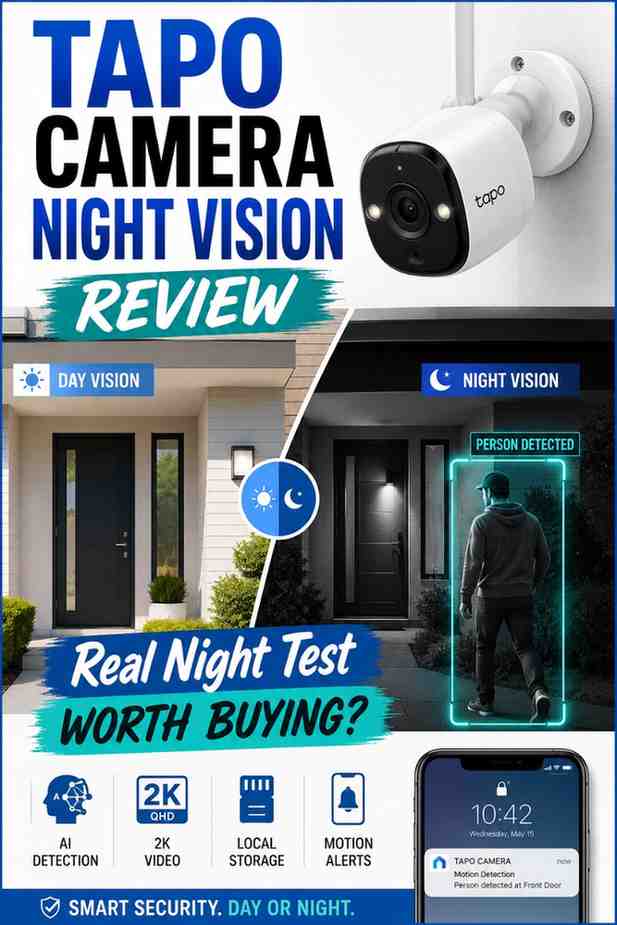
Is Tapo Camera Night Vision Good?
Yes, Tapo Camera night vision is very good for most homes when installed correctly. The Tapo Camera produces clear infrared footage in complete darkness, while selected models also support color night vision under low ambient lighting. Consequently, front doors, hallways, garages, and small driveways remain well monitored throughout the night.
After reviewing how the Tapo Camera behaves in everyday situations, image clarity remains dependable within realistic home surveillance distances instead of only laboratory conditions. Furthermore, AI motion detection continues working effectively after sunset, making the camera suitable for everyday security.
Who this camera is best for
The Tapo Camera is best for homeowners, renters, and small business owners looking for affordable night surveillance. The combination of infrared illumination, AI detection, and local recording provides excellent value without requiring expensive equipment.
Apartment residents can also benefit from a compact indoor camera placed near an entrance or window. If you are still deciding which model suits your property, explore our guide to the best Tapo camera for apartment security.
Situations where it performs well
The Tapo Camera performs best in predictable home environments with controlled lighting. Front entrances, living rooms, nurseries, garages, hallways, and covered patios all benefit from consistent infrared illumination and reliable motion detection.
During overnight monitoring, the Tapo Camera generally produces cleaner footage when outdoor lighting such as porch lamps or nearby streetlights is available. As a result, supported models with color night vision retain more scene detail than infrared-only recording.
Main strengths at a glance
The Tapo Camera stands out because it combines affordability with practical smart security features. Unlike many entry-level security cameras, several Tapo models include AI-powered person detection, local microSD recording, mobile notifications, and high-resolution video without requiring premium hardware.
- Clear infrared night vision
- Available color night vision on selected models
- AI person detection on supported cameras
- Local microSD recording
- Optional cloud storage
- Easy installation through the Tapo app
- Competitive pricing compared with many rivals
Key limitations to know
The Tapo Camera still has limitations despite offering excellent value. Image quality gradually decreases as viewing distance increases, while reflective walls, windows, and heavy rain may reduce nighttime clarity.
Additionally, cloud features vary between models, and continuous recording depends on storage configuration. Before choosing a recording method, you may also want to read whether Tapo cameras can record without a subscription.
Bottom Line: The Tapo Camera delivers dependable night vision for most homes, especially when installed correctly with realistic expectations about viewing distance and lighting conditions.
Tapo Camera Night Vision Specifications
Tapo Camera specifications explain why the camera performs well after dark. Infrared LEDs, AI-assisted motion detection, high-resolution sensors, and flexible storage options work together to provide dependable nighttime monitoring.
Infrared and color night vision features
The Tapo Camera primarily relies on infrared LEDs to capture clear images in complete darkness. Infrared light remains invisible to the human eye while allowing the camera sensor to record detailed monochrome footage throughout the night.
Meanwhile, selected models such as higher-end outdoor cameras include color night vision. Instead of relying only on infrared, the Tapo Camera uses available ambient lighting or integrated spotlights to preserve color details that may help identify clothing, vehicles, or packages.
Video resolution and image quality
The Tapo Camera offers multiple recording resolutions depending on the model. Popular cameras provide Full HD 1080p recording, while premium versions capture sharper 2K or higher resolution footage for improved detail.
Higher resolution does not automatically improve night vision. However, increased pixel density helps the Tapo Camera preserve facial features, objects, and movement when adequate infrared illumination reaches the subject.
Motion detection and AI capabilities
The Tapo Camera combines motion sensors with AI detection to reduce unnecessary alerts. Supported models distinguish between people, pets, vehicles, and general movement, helping minimize false notifications caused by insects or moving tree branches.
Furthermore, adjusting motion sensitivity significantly improves detection accuracy. If your camera frequently misses movement or triggers unnecessary alerts, follow our guide to fix Tapo motion detection problems.
Storage and recording options
The Tapo Camera supports both local and cloud recording depending on the model. Local recording uses a compatible microSD card, while cloud storage provides remote access and additional backup options through the Tapo Care service.
Choosing the correct memory card improves recording reliability, especially for continuous overnight footage. Therefore, review our guide to the best SD card size for Tapo cameras before purchasing storage.
Internet bandwidth also affects continuous recording performance. If your home network has limited capacity, learn more about Tapo camera internet data usage before enabling around-the-clock monitoring.
Official documentation from TP-Link provides detailed specifications for each model, while compatibility information can also be verified through the Tapo app before installation.
Bottom Line: The Tapo Camera combines infrared technology, AI detection, flexible storage, and high-resolution recording to deliver reliable night surveillance across a wide range of home security scenarios.
Real-World Night Vision Performance
The Tapo Camera delivers dependable night vision in everyday home environments when installed correctly. Real-world performance depends on camera placement, available lighting, recording resolution, and motion settings rather than the advertised night vision distance alone. Consequently, evaluating practical scenarios provides a more accurate picture than relying only on specifications.
Performance in complete darkness
The Tapo Camera continues recording clear footage even in complete darkness by using built-in infrared LEDs. Infrared illumination remains invisible to the human eye, allowing the camera sensor to capture black-and-white images without requiring additional lighting.
After installing the Tapo Camera in a hallway with no ambient light, nearby objects remain easy to recognize, while faces approaching the camera stay identifiable at normal entrance distances. However, smaller details naturally become softer as the subject moves farther away.
Proper mounting height also improves infrared coverage. Placing the Tapo Camera approximately 7 to 9 feet above the ground helps reduce blind spots while maintaining better facial visibility near entry points.
Performance with outdoor lighting
The Tapo Camera produces noticeably better nighttime images when low ambient lighting is available. Porch lights, pathway lighting, or nearby streetlights allow supported models with color night vision to preserve clothing colors, vehicles, and package details that infrared recording cannot reproduce.
Meanwhile, excessive lighting can create unwanted glare if the Tapo Camera faces reflective walls, glass doors, or polished vehicles. Adjusting the viewing angle usually delivers better results than increasing image brightness.
Outdoor placement also benefits from avoiding direct exposure to bright security lights. Instead, positioning the Tapo Camera slightly away from intense light sources creates a more balanced nighttime image.
Face and object recognition distance
The Tapo Camera identifies faces more reliably at common residential distances than at the maximum advertised night vision range. Manufacturers often specify how far infrared illumination reaches, but recognizable facial detail usually requires subjects to remain considerably closer.
When reviewing overnight footage the next morning, the Tapo Camera generally captures enough detail for identifying visitors approaching a front door, driveway entrance, or hallway. Additionally, package deliveries, parked vehicles, and larger objects remain easy to distinguish when the camera has an unobstructed view.
Digital zoom can enlarge recorded footage, although zooming cannot recover details that were never captured. Therefore, selecting a higher-resolution Tapo Camera often provides more useful evidence than depending heavily on digital magnification.
Motion detection accuracy at night
The Tapo Camera maintains accurate motion detection after dark when sensitivity settings match the environment. AI-powered person detection available on supported models reduces unnecessary notifications caused by moving shadows, insects, or swaying plants.
Furthermore, adjusting activity zones helps the Tapo Camera focus only on important areas such as entrances, gates, garages, or walkways. As a result, notification quality improves while reducing alert fatigue during overnight monitoring.
Continuous nighttime recording also generates larger video files. Before enabling around-the-clock surveillance, review our guide on Tapo camera internet data usage if your internet connection has bandwidth limits.
Bottom Line: The Tapo Camera performs best at realistic residential distances, where infrared illumination, AI motion detection, and thoughtful placement work together to produce dependable overnight surveillance.
Night Vision Strengths and Limitations
The Tapo Camera offers an excellent balance between affordability and practical night surveillance, but every security camera has limitations. Understanding both strengths and weaknesses helps you choose the right model while setting realistic expectations for nighttime monitoring.
What impressed us most
The Tapo Camera stands out because it combines useful AI features with reliable infrared performance at an affordable price. Instead of requiring expensive hardware, many models include person detection, local recording, smartphone notifications, and sharp nighttime footage suitable for everyday home security.
Another advantage is the flexibility of the Tapo Camera ecosystem. Indoor cameras, outdoor models, pan-and-tilt units, and higher-resolution options all share the same Tapo application, making future upgrades straightforward.
If you are comparing several models before purchasing, our guide to the best Tapo cameras explains which option fits different homes and budgets.
Where night vision struggles
The Tapo Camera performs less effectively when environmental conditions reduce image quality. Heavy rain, dense fog, dirty camera lenses, and reflective surfaces can all reduce infrared effectiveness during nighttime recording.
Likewise, insects flying close to infrared LEDs sometimes trigger unnecessary motion alerts because the Tapo Camera detects nearby movement before recognizing distant subjects. Cleaning the lens regularly and adjusting sensitivity usually minimizes these interruptions.
Bright headlights directed toward the Tapo Camera may temporarily reduce visible detail. Repositioning the camera slightly away from vehicle approach angles often produces a clearer image.
Common issues users may notice
The Tapo Camera occasionally experiences issues that are easy to correct through proper setup. Blurry nighttime footage usually results from fingerprints on the lens, incorrect focus distance, poor placement, or unsuitable lighting instead of hardware failure.
Some homeowners also notice delayed alerts after changing Wi-Fi equipment or router settings. If installation problems occur, follow our guide on how to set up a Tapo camera without a QR code before attempting a factory reset.
Internet outages create another common concern. Fortunately, local recording continues on compatible models equipped with a microSD card. You can also learn whether a Tapo camera works without Wi-Fi during temporary connection interruptions.
Tips for improving night image quality
The Tapo Camera produces better night footage when installation follows a few simple best practices. Position the camera where infrared light can spread evenly across the monitored area without reflecting directly into the lens.
- Mount the Tapo Camera about 7 to 9 feet above ground level.
- Clean the camera lens regularly to remove dust and fingerprints.
- Avoid pointing the camera directly toward reflective glass or polished metal.
- Enable AI person detection when available.
- Adjust motion sensitivity after sunset instead of using daytime settings.
- Use soft outdoor lighting if your Tapo Camera supports color night vision.
Finally, updating firmware through the Tapo application ensures the Tapo Camera receives the latest motion detection improvements, security patches, and performance optimizations published by TP-Link.
Bottom Line: The Tapo Camera delivers strong night vision for most homes, and careful placement, regular maintenance, and proper configuration noticeably improve image quality and motion detection accuracy.
Tapo Night Vision Compared with Other Security Cameras
The Tapo Camera offers one of the best balances between price, image quality, and local storage for home security. However, choosing the right camera depends on whether you prioritize subscription-free recording, AI detection, or advanced smart home integration.
| Camera | Night Vision | Resolution | Local Storage | Subscription | Best For |
|---|---|---|---|---|---|
| Tapo Camera | Infrared and color on selected models | 1080p to 2K+ | Yes | Optional | Affordable home security |
| Blink | Infrared | 1080p | Limited by model | Recommended | Battery-powered installations |
| Ring | Infrared and color on selected models | 1080p | Limited | Recommended | Alexa ecosystem |
| Wyze | Infrared and color on selected models | 2K on newer models | Yes | Optional | Budget smart homes |
Tapo vs Blink
The Tapo Camera provides more flexibility than Blink if local recording and advanced AI features matter to you. Many Tapo Camera models support continuous recording to a microSD card, whereas Blink focuses more on battery life and cloud-connected convenience.
Additionally, the Tapo Camera ecosystem offers a wider range of indoor and outdoor models with pan-and-tilt options. If you rent your home and are deciding between the two brands, read our comparison of Tapo vs Blink for renters.
Tapo vs Ring
The Tapo Camera is usually the better value for buyers who prefer local storage and lower long-term costs. Ring cameras integrate exceptionally well with Amazon Alexa, but many advanced recording features work best with a subscription.
Meanwhile, the Tapo Camera allows many homeowners to record locally without paying a recurring monthly fee. Therefore, ongoing ownership costs can remain lower over several years.
Tapo vs Wyze
The Tapo Camera and Wyze cameras are closely matched, but each serves slightly different priorities. Wyze frequently introduces advanced AI features, while the Tapo Camera platform emphasizes straightforward setup, dependable local recording, and a simple mobile application.
Both ecosystems offer strong value in the budget security camera market. Consequently, your decision often depends on preferred software features, smart home compatibility, and camera placement.
Which camera offers the best value?
The Tapo Camera delivers the best overall value for most homeowners looking for reliable night vision without mandatory subscription costs. Affordable pricing, flexible storage, AI-assisted motion detection, and multiple camera options make the platform suitable for apartments, family homes, garages, and small offices.
Bottom Line: The Tapo Camera stands out because it combines dependable night vision, optional cloud services, and local recording at a competitive price.
Frequently Asked Questions
Does Tapo Camera work in complete darkness?
Yes, the Tapo Camera works in complete darkness by using built-in infrared LEDs. Infrared illumination allows the camera to capture black-and-white footage without visible light. For the best results, keep the camera lens clean and avoid placing reflective objects directly in front of the camera.
How far can Tapo Camera see at night?
The Tapo Camera can monitor areas well beyond typical entryways, but recognizable detail is strongest at normal residential distances. Maximum infrared range differs by model, while face recognition depends on lighting, camera height, recording resolution, and the subject’s distance from the lens.
Can Tapo Camera recognize faces at night?
Yes, the Tapo Camera can capture recognizable faces at night when subjects remain within practical viewing distance. Higher-resolution models generally preserve more facial detail, especially when additional ambient lighting is available or color night vision is supported.
Does Tapo Camera record without a subscription?
Yes, many Tapo Camera models record without a subscription by saving footage directly to a compatible microSD card. Cloud recording remains optional through Tapo Care, giving you the flexibility to choose local storage, cloud storage, or both depending on your security needs.
Which Tapo Camera has the best night vision?
Higher-end Tapo Camera models generally provide the best night vision because they combine improved sensors with higher resolution and advanced AI features. Outdoor models supporting color night vision also preserve additional scene detail when low ambient lighting is available.
Is Tapo Camera better than Blink at night?
For many homeowners, the Tapo Camera offers better nighttime value thanks to flexible recording options and strong image quality. Blink remains an excellent choice for battery-powered installations, while the Tapo Camera is often preferred when continuous local recording and lower ownership costs are priorities.
Final Verdict
Who should buy a Tapo Camera
The Tapo Camera is an excellent choice for homeowners, apartment residents, and small business owners seeking dependable night surveillance. Anyone who values local recording, AI motion detection, and affordable hardware will find the platform particularly appealing.
Who should consider another option
Some buyers may prefer another camera ecosystem if advanced smart home integration or specialized outdoor features are higher priorities. For example, households deeply invested in a particular smart home platform may benefit from choosing cameras designed specifically for that ecosystem.
Overall rating
| Category | Rating |
|---|---|
| Night Vision Quality | 9.0/10 |
| Motion Detection | 9.0/10 |
| Ease of Setup | 9.5/10 |
| Value for Money | 9.5/10 |
| Overall | 9.2/10 |
Bottom line
The Tapo Camera is worth buying if dependable night vision, flexible recording options, and strong value are your priorities. Rather than relying on marketing claims, the platform delivers practical performance that suits most homes, apartments, garages, and small businesses while keeping long-term ownership costs manageable.
For the latest specifications, firmware updates, and compatibility details, consult the official TP-Link documentation before choosing a specific model.